
Written by: Aditi Koli, Content Writer
Reviewed & Edited by: Dr. Dooa Arif, Content Strategist
Estimated Reading Time: 8 minutes
TL;DR
Yin yoga focuses on slow, deeply restorative poses that target connective tissues rather than muscles-exactly what modern, fast-paced bodies need. By holding poses like Dragon, Butterfly, and Sphinx for several minutes, it enhances flexibility, joint mobility, and emotional calm. Practising yin before bed supports deeper sleep, while specific sequences ease hip and hamstring tightness built from long hours of sitting. Aligned with seasonal energy, summer yin routines favour heart-opening and cooling postures. Ultimately, yin yoga offers balance through stillness-releasing tension, improving circulation, and nurturing both body and mind.
Yin yoga represents a paradigmatic shift from dynamic practices toward sustained passive holding targeting deep fascial networks. Unlike yang-oriented styles emphasizing muscular engagement, these restorative poses apply gentle stress to connective tissues-ligaments, tendons, and fascia-promoting plastic deformation and enhanced joint mobility.
Extended holds of three to five minutes allow muscles to release completely, transferring tension into deeper connective structures. Research demonstrates that sustained passive stretching increases collagen production within fascial networks, improving fascial health, tissue hydration and mobility¹.
Traditional Chinese medicine principles inform yin yoga’s philosophical foundation, viewing extended holding as meridian stimulation facilitating chi flow. Contemporary wellness culture emphasizes constant activity, whilst yin practice counterbalances this through cultivated stillness, encouraging parasympathetic nervous system dominance. Studies indicate that regular yin practice reduces anxiety symptoms whilst improving emotional regulation capacities².
Essential 5 Yin Yoga Poses for Foundation Building
These 5 yoga poses represent core positions frequently referenced across poses chart systems and teaching lineages.
Foundational Yin Asanas:
- Dragon Pose (Anjaneyasana Variation): A deep hip flexor and quadriceps stretch accessed through low lunge positioning with extended holds.
- From tabletop, step your right foot forward between your hands
- Lower your left knee to the floor, sliding it back until you feel a stretch in the hip flexor
- Rest your hands on blocks or the floor, keeping your spine long
- Hold for 3-5 minutes, then switch sides
- Butterfly Pose (Baddha Konasana): The primary focus of the pose is on adductors (inner thighs) and groin stretching.
- Sit on the floor and bring the soles of your feet together
- Allow your knees to fall open toward the floor
- Fold forward from your hips, rounding your spine naturally
- Hold for 3-5 minutes, using props under knees if needed
- Caterpillar Pose (Paschimottanasana Variation): A comprehensive posterior chain stretch targeting hamstrings, spine, and kidney meridian
- Sit with legs extended straight in front of you
- Fold forward from your hips, allowing your spine to round completely
- Let your head hang heavy, reaching toward feet without forcing
- Hold for 3-5 minutes, placing a bolster on thighs for support if needed
- Sleeping Swan (Pigeon Pose Variation): An intense hip external rotator stretch addressing piriformis tightness and sciatic tension. The Sleeping Swan variation can be intense, and proper modifications or props (like a blanket or block under the hips) are recommended for those with limited flexibility.
- From tabletop, bring your right knee forward behind your right wrist
- Slide your left leg back, lowering your hips toward the floor
- Fold forward over your front leg, resting on forearms or forehead
- Hold for 3-5 minutes, then switch sides, using props under hip as needed
- Sphinx Pose (Salamba Bhujangasana): A gentle backbend compressing lumbar spine whilst opening anterior thoracic structures
- Lie on your belly with legs extended behind you
- Place your forearms on the floor, elbows under shoulders
- Press forearms down, lifting your chest whilst keeping hips grounded
- Hold for 3-5 minutes, relaxing shoulders away from ears
Additional poses include Child’s Pose for spinal decompression, Saddle Pose for quadriceps release, Twisted Root for spinal rotation, Shoelace Pose for hip opening, and Savasana for integration. Together, these positions address major joint complexes requiring regular maintenance for optimal function.
Key Takeaways: These foundational yin poses establish core competencies whilst addressing major tissue systems.
Poses Before Bed for Deep Sleep
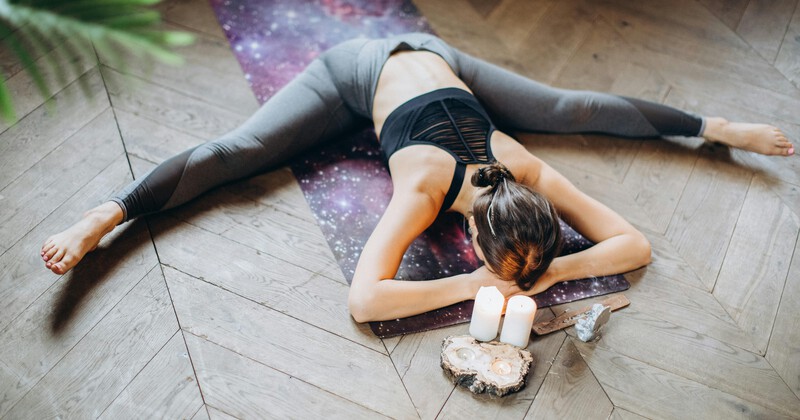
Evening yin practice offers powerful sleep preparation benefits through nervous system downregulation and physical tension release. These poses before bed specifically target common stress areas whilst promoting parasympathetic activation essential for quality rest. Research demonstrates that 20-minute pre-sleep yin sequences improve sleep onset latency whilst increasing deep sleep duration³.
Optimal bedtime sequences emphasize supine and prone positions minimizing cardiovascular demand. Beginning with gentle Caterpillar forward folds transitions naturally into Butterfly, then Reclined Twist, Legs-Up-The-Wall, and concluding with extended Savasana. This progression systematically releases major muscle groups whilst gradually reducing arousal levels.
Key Takeaways: Evening yin sequences improve sleep quality through nervous system downregulation, with research showing 35% faster sleep onset. Optimal practices emphasize supine positions and 60-90 minute pre-sleep timing.
Poses for Hip Flexors and Tight Hamstrings
Targeted poses for hip flexors and tight hamstrings address these restrictions through sustained passive stretching that remodels shortened tissues over time.
Hip flexor tightness stems primarily from prolonged sitting. Dragon Pose variations provide optimal hip flexor release, with anterior pelvic positioning creating sustained stretch along the entire hip flexor chain..
Hamstring restrictions affect functional movements from bending to walking. Caterpillar Pose, Half Saddle variations, and Sleeping Swan target hamstring length through different angles, providing comprehensive posterior chain release.
Key Takeaways: Targeted yin poses address hip flexor and hamstring tightness through sustained holds that remodel shortened connective tissues, with consistent practice producing permanent structural improvements over weeks and months.
Seasonal Alignment: Poses for Summer
Summer corresponds to the fire element in five-element theory, governing cardiovascular function and emotional expression. Appropriate summer yin sequences emphasize heart-opening positions like Melting Heart (Anahatasana), gentle twists stimulating small intestine meridian, and cooling postures reducing excess heat accumulation.
Summer yin embraces more yang characteristics-shorter hold durations (2-3 minutes versus 5+ minutes as the fire element is more active and energetic, requiring a balance of yin and yang practices), increased sequence variety, and outdoor practice when appropriate.
FAQs
Wall yin yoga poses include Legs-Up-The-Wall (Viparita Karani), Supported Fish Pose against the wall, Wall Butterfly, Reclining Twist with feet on wall, and Supported Bridge with feet elevated on the wall.
The four principles of yin yoga are: find an appropriate edge (depth), resolve to remain still, hold the pose for time (3-5 minutes), and release with mindful care.
References
- Zügel, M., Maganaris, C. N., Wilke, J., Jurkat-Rott, K., Klingler, W., Wearing, S. C., Findley, T., Barbe, M. F., Steinacker, J. M., Vleeming, A., Bloch, W., Schleip, R., & Hodges, P. W. (2018). Fascial tissue research in sports medicine: From molecules to tissue adaptation, injury and diagnostics: Consensus statement. British Journal of Sports Medicine, 52(23), 1497.”Fascial tissue research in sports medicine from molecules to tissue adaptation, injury and diagnostics..pdf
- Daukantaitė, D., Tellhed, U., Maddux, R. E., Svensson, T., & Melander, O. (2018). Five-week Yin yoga–based interventions decreased plasma adrenomedullin and increased psychological health in stressed adults: A randomized controlled trial. PLOS ONE, 13(7), e0200518. Five-week yin yoga-based interventions decreased plasma adrenomedullin and increased psychological health in stressed adults: A randomized controlled trial | PLOS One
- PLOS ONE (2018) — Five-week Yin yoga–based RCT in stressed adults: reduced insomnia scores and improved psychological health. https://journals.plos.org/plosone/article?id=10.1371/journal.pone.0200518
Get in Touch with Us
We’d love to hear from you—share your thoughts or ask a question!