


Written by: Aditi Koli, Content Writer
Reviewed & Edited by: Dr. Dooa Arif, Content Strategist
Estimated Reading Time: 6 minutes
TL;DR
Couple yoga turns exercise into shared mindfulness-deepening connection while improving strength and flexibility. Simple poses like Partner Breathing or Double Tree foster synchrony and trust, while intermediate ones such as Flying Warrior or Partner Boat challenge balance and communication. Practising together boosts oxytocin, reduces stress, and enhances relationship satisfaction. With proper warm-up, mutual respect, and supportive adjustments, partner yoga transforms date night into a grounding, heart-opening ritual that nurtures both body and bond.
Partner yoga transforms the traditional solo practice into a shared journey of growth and connection. Unlike conventional approach, this collaborative approach requires communication, trust, and synchronised breathing between partners. Research has found that couples who engage in novel, challenging activities together report increased relationship satisfaction¹.
When you practise poses for couple wellness, you’re not simply exercising-you’re building a foundation of mutual support. The physical touch involved in partner poses releases oxytocin, often called the “bonding hormone,” which strengthens emotional intimacy². This makes couples poses for intimacy particularly valuable for maintaining healthy relationships.
Whether you’re trying couples beach poses during a holiday or practising in your living room, the shared experience creates lasting memories whilst improving your physical health.
Essential Benefits of Partner Yoga
Beyond the physical realm, partner yoga cultivates emotional resilience. Studies indicate that synchronised movement between partners can reduce cortisol levels³. This stress reduction creates space for meaningful connection.
The practice also develops practical relationship skills. You’ll learn to communicate non-verbally, respect boundaries, and offer support-all whilst working towards common goals. For poses for couples beginner sessions, this collaborative element makes the practice less intimidating than solo classes.
Some of the physical advantages of indulging in Partner Poses are:
- Enhanced flexibility through assisted stretching
- Improved balance using your partner as a counterweight
- Deeper stretches than solo practice allows
- Increased strength from supporting each other’s body weight
- Better posture through alignment awareness
Key Takeaways: Partner yoga offers both physical benefits like enhanced flexibility and emotional advantages including stress reduction and improved communication.
Getting Started: Couple Preparation Tips
Before attempting any poses for couple practice, proper preparation ensures safety and enjoyment:
Essential Preparation Steps:
- Wear comfortable, fitted clothing that allows movement
- Choose a quiet space with adequate room for two yoga mats
- Warm up individually for 5-10 minutes with gentle stretches
- Establish verbal cues for discomfort or needing to pause
- Begin with shorter 20-minute sessions, gradually extending duration
Communication forms the cornerstone of successful partner practice. Discuss any injuries, flexibility limitations, or areas of discomfort beforehand. Remember, this isn’t a competition—partners may have different flexibility levels, and that’s perfectly acceptable.
Consider practising near a wall initially for additional support. Some practitioners enjoy ambient music or nature sounds, whilst others prefer silence to focus on breathing synchronisation.
Key Takeaways: Creating a supportive environment ensures both partners feel safe exploring new movements together.
Beginner-Friendly Partner Poses
Partner Breathing
- Sit back-to-back with spines touching, legs crossed comfortably.
- Close your eyes and synchronise your breathing, feeling your partner’s breath rhythm.
This foundational practice establishes connection before attempting physical poses.
Double Tree Pose
- Stand side-by-side, wrapping your inner arms around each other’s waist.
- Both partners lift their outer legs, placing feet against inner thighs.
This yoga poses for couples beginner option improves balance whilst building trust.
Seated Forward Fold
- One partner sits with legs extended whilst the other stands behind, gently pressing on their shoulders to deepen the forward fold.
- Switch roles after 30 seconds.
This assisted stretch increases flexibility safely.
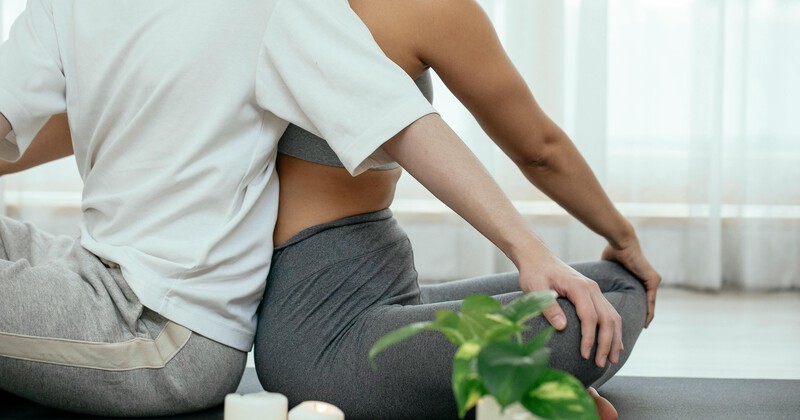
Partner Twist
- Sit cross-legged, back-to-back.
- Both partners twist to the right, placing left hands on their own right knees and right hands on their partner’s left knee.
- Hold for five breaths, then switch sides.
These foundational poses work excellently as couples beach yoga poses, where the natural setting enhances relaxation and mindfulness.
Key Takeaways: Beginner couple yoga poses focus on balance, trust, and assisted stretching without requiring advanced flexibility.
Intermediate Poses for Deeper Connection
Partner Boat Pose
Sit facing each other, knees bent, toes touching.
Hold each other’s wrists and slowly straighten legs upward, creating a “V” shape with your bodies.
According to yoga therapy research, this pose engages core muscles more effectively than solo practice⁴.
Double Downward Dog
One partner assumes standard downward dog position.
The second partner places hands approximately one metre in front, then carefully places feet on their partner’s lower back, creating a stacked downward dog.
Double Downward Dog is an advanced pose that requires core strength, balance, and clear communication between partners. Proper alignment and caution are crucial. The feet should be placed carefully, and the partners should check in with each other to avoid any strain or injury. This is especially important for beginners who may not have the same level of experience or flexibility.
Flying Warrior
The base partner lies on their back, knees bent, feet raised.
The flying partner balances their hips on the base’s feet whilst extending arms forward and legs back.
This pose exemplifies couples yoga poses for intimacy, requiring complete trust and clear communication.
Supported Backbend
One partner sits cross-legged whilst the other carefully leans back over them, creating a supported chest opener.
The seated partner provides stability whilst the other experiences a gentle, safe backbend.
Key Takeaways: Intermediate poses require increased trust and communication whilst offering deeper stretches and greater physical challenges. Caution is advised with backbends, especially for beginners or individuals with existing back conditions.

Safety Considerations and Modifications
Never force yourselves into positions that cause pain. Discomfort during stretching differs from sharp pain-learn to recognise this distinction. If either partner experiences concerning sensations, exit the pose immediately.
Individuals with specific conditions should consult healthcare providers before starting:
- Recent surgeries or injuries
- Pregnancy (certain poses require modification)
- Chronic back or joint problems
- High blood pressure or heart conditions
- Vertigo or balance disorders
Modifications make poses accessible regardless of flexibility differences. Use yoga blocks, bolsters, or folded blankets to bridge gaps between partners’ abilities.
Remember, yoga poses for couple wellness should feel supportive, never competitive.
Key Takeaways: Prioritise safety through clear communication, proper warm-ups, and respecting physical limitations. Modifications and props ensure both partners benefit regardless of experience levels or flexibility differences.
FAQs
Fun partner yoga poses include Double Tree Pose for balance, Flying Warrior for trust-building, Partner Boat Pose for core strength, and back-to-back twists for gentle stretching and connection.
The best partner yoga poses for flexibility include Seated Forward Fold with assistance, Partner Straddle Stretch, Supported Backbend, Double Pigeon Pose, and assisted Shoulder Opener variations.
References
- Aron, A., Norman, C. C., Aron, E. N., McKenna, C., & Heyman, R. E. (2000). Couples’ shared participation in novel and arousing activities and experienced relationship quality. Journal of Personality and Social Psychology, 78(2), 273–284. Couples’ shared participation in novel and arousing activities and experienced relationship quality – PubMed
- American Psychological Association. (2021, November). Cultivating empathy. Monitor on Psychology. (Feature referencing oxytocin and affiliative touch):Cultivating empathy
- Djalovski, A., Kinreich, S., Zagoory-Sharon, O., & Feldman, R. (2021). Social dialogue triggers biobehavioral synchrony of partners’ endocrine response via sex-specific, hormone-specific, attachment-specific mechanisms. Scientific Reports, 11, 12421 (Scientific Reports, 2021): https://www.nature.com/articles/s41598-021-91626-0
- Ni, M., Mooney, K., Harriell, K., Balachandran, A., & Signorile, J. (2014). Core muscle function during specific yoga poses. Complementary Therapies in Medicine, 22(2), 235–243 Core muscle function during specific yoga poses – PubMed
Get in Touch with Us
We’d love to hear from you—share your thoughts or ask a question!