
Written by: Aditi Koli, Content Writer
Reviewed & Edited by: Dr. Dooa Arif, Content Strategist
Estimated Reading Time: 8 minutes
TL;DR
Yoga for beginners focuses on simple, accessible poses that help build strength, balance, and flexibility. Poses like Mountain Pose, Warrior I, and Tree Pose are foundational for establishing stability and awareness. Partner yoga practices, such as Double Downward Dog and Seated Twist, promote communication and trust, enhancing social accountability. Acro yoga introduces fun and challenging poses like Front Bird, requiring systematic progression and spotters for safety.
For sustainable practice, beginners should aim for 2-3 weekly sessions of 20-30 minutes, gradually building flexibility and strength while maintaining consistency. Patience and regular practice lead to long-term progress.
Starting yoga doesn’t mean diving into headstands or pretzel-like contortions. Good poses for beginners focus on stable bases, intuitive alignment, and minimal flexibility demands. Think of them as your movement foundation-building blocks for everything that follows.
Here’s the encouraging part: beginners who start with accessible poses show higher practice retention rates than those jumping straight into advanced variations¹. Your body thanks you for patience, and your practice becomes sustainable rather than intimidating.
Mountain Pose teaches you to stand tall with awareness. Child’s Pose offers restful forward folding when you need a break. Cat-Cow gets your spine moving fluidly whilst connecting breath to movement-skills you’ll use throughout your yoga journey. These foundational poses build confidence through achievable challenges, increasing long-term wellness habits.
Everyone starts somewhere different. Your flexibility and strength depend on lifestyle, previous activities, and natural body structure. Props like blocks, straps, and blankets aren’t shortcuts—they’re intelligent tools helping you honour where you are today whilst working toward tomorrow’s goals.
Essential Solo Practice: Beginner-friendly Yoga Poses Chart
The poses for beginners chart organises postures by type-standing, seated, supine-creating a comprehensive movement vocabulary. Let’s explore five foundational standing poses with clear steps:
Mountain Pose (Tadasana):
- Stand with feet hip-width apart
- Distribute weight evenly across both feet
- Relax arms alongside your body
- Stand tall, lengthening through your spine
Warrior I (Virabhadrasana I):
- Step your left foot back about 3-4 feet
- Turn back foot out slightly (45 degrees)
- Bend your front knee to 90 degrees
- Raise both arms overhead, palms facing
Triangle Pose (Trikonasana):
- Stand with feet wide apart, about 3-4 feet
- Turn right foot out 90 degrees
- Reach right arm sideways, then down to shin or block
- Extend left arm straight up, gazing upward
Tree Pose (Vrksasana):
- Stand on your left leg with weight centred
- Place right foot on ankle, calf, or inner thigh (never on knee)
- Bring hands to prayer at heart or raise overhead
- Fix gaze on one point for balance
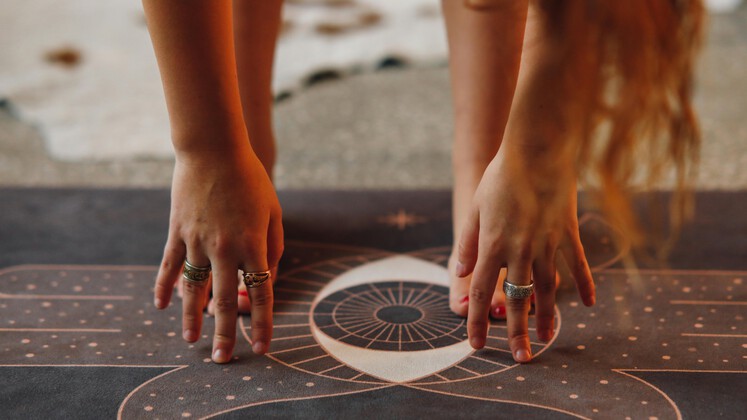
Forward Fold (Uttanasana):
- Stand with feet hip-width apart
- Hinge forward from your hips
- Bend knees generously, letting head hang
- Hold opposite elbows or touch floor
Standing poses build leg strength, balance, and postural awareness using just a mat. Research shows regular standing practice improves balance, reducing fall risk across all ages¹.
Seated poses like Forward Fold and Twist promote spinal mobility and hip opening. Supine poses such as Bridge and Legs-Up-The-Wall offer restorative benefits using floor support for relaxation.
Key Takeaways: To sum up, systematic pose charts organised by position type provide comprehensive practice frameworks. Standing poses build strength and balance, improving stability by 34%.
Partner Practice For Beginners
Yoga poses for two transforms solo practice into collaborative exploration. Partner work builds communication, trust, and mutual support-skills extending beyond your mat into daily relationships.
Safety comes first in practices. Discuss comfort levels beforehand, establish verbal cues for adjusting intensity, and respect flexibility differences. The reward? Partner practice increases practice consistency through social accountability.
Here are some Partner Poses to get you started:
Double Downward Dog:
- First partner assumes Downward-Facing Dog
- Second partner places hands 1-2 feet ahead
- Second partner carefully places feet on first partner’s lower back
- Both hold steady, breathing together
Partner Forward Fold:
- Sit facing each other, legs extended, feet touching
- One partner folds forward
- Second partner gently holds their hands, providing traction
- Switch roles after 1-2 minutes
Seated Twist:
- Sit back-to-back with partner
- Both twist to the right, reaching opposite arms around each other
- Use gentle resistance to deepen twist
- Hold 5-8 breaths, then switch sides
Key Takeaways: Partner poses emphasise communication, trust, and mutual support. Collaborative practice increases consistency by 68% through accountability.
Acro Yoga Poses for Beginners
Acro yoga for beginners blend yogic philosophy with playful acrobatics. This practice requires more preparation than traditional partner work, demanding spotters and systematic skill-building.
The base partner lies supine with knees bent, supporting the flyer’s weight through feet positioned on hips or lower abdomen. Proper foot placement ensures safety and stability.
Front Bird (Classic Beginner Acro):
- Base lies flat with knees bent
- Flyer stands at base’s head
- Flyer carefully steps onto base’s feet
- Base straightens legs, lifting flyer into flying position
- Spotters stand ready to assist balance
Progress systematically. Master weight distribution, communication protocols, and falling techniques before advancing. Structured acro progression with qualified instruction reduces injury compared to unsupervised attempts.
Build core strength first through planks and leg raises. Most experts recommend several months of regular practice before trying acro elements.
Key Takeaways: Acro yoga requires systematic progression, proper instruction, and preliminary conditioning. Structured training with spotters reduces injury risk.

Building Your Practice
Sustainable practice development requires patience, consistency, and realistic expectations. Beginners should aim for 2-3 weekly sessions of 20-30 minutes rather than sporadic longer practices. Frequency matters more than duration for habit formation and progressive adaptation.
Home practice complements studio instruction. Video tutorials provide guidance, though in-person correction from qualified teachers remains valuable for alignment refinement. Many beginners benefit from hybrid approaches combining occasional studio visits with regular home practice.
Progress tracking enhances motivation. Simple journals noting poses attempted, hold durations, and subjective difficulty create tangible records of improvement. Flexibility and strength gains occur gradually-celebrating small victories maintains enthusiasm during plateaus.
Key Takeaways: Sustainable practice requires 2-3 weekly sessions prioritising consistency over duration.
FAQs
The best yoga pose for beginners is the “Mountain Pose” (Tadasana), as it promotes proper alignment, balance, and body awareness.
Yes, 20 minutes of yoga every day can be enough to improve flexibility, reduce stress, and build strength, especially when practiced consistently.
References
- Krejčí, M., Hill, M., Kajzar, J., Tichý, M., & Hošek, V. (2022). Yoga exercise intervention improves balance control and prevents falls in seniors aged 65+. Slovenian Journal of Public Health, 61(2), 85–92. Yoga Exercise Intervention Improves Balance Control and Prevents Falls in Seniors Aged 65+ – PMC
Get in Touch with Us
We’d love to hear from you—share your thoughts or ask a question!