
Written by: Aditi Koli, Content Writer
Reviewed & Edited by: Dr. Dooa Arif, Content Strategist
Estimated Reading Time: 8 minutes
TL;DR
Easy yoga poses offer a gentle way to feel lighter, calmer, and more energised in just ten minutes.
Simple postures like Supine Twist, Legs-Up-the-Wall, and Child’s Pose help release daily tension, improve digestion, and promote relaxation. Core-focused moves such as modified Boat and Plank support abdominal toning while regulating stress hormones linked to belly fat. Forward folds encourage mental clarity and emotional grounding, easing anxiety and improving sleep. Ideal for beginners, these easy-to-learn poses prove that effective yoga isn’t about complexity-it’s about consistency, breath, and mindful movement.
When examining yoga poses that are easy, it helps to identify asanas requiring minimal flexibility, moderate strength, and straightforward alignment principles that accommodate diverse body types and physical capabilities.
“Easy” poses yoga practitioners favour share common characteristics: stable base support, intuitive body positioning, reduced balance demands, and clear entry-exit pathways. Research indicates that beginners who start with accessible postures demonstrate higher practice retention rates compared to those attempting advanced variations prematurely¹.
Simple asanas build confidence through achievable challenges, creating positive reinforcement loops that encourage consistent practice. This neurological reward pathway activation explains why certain yoga sequences effectively establish long-term wellness habits.
Contemporary pedagogy emphasises meeting practitioners where they exist rather than imposing standardised expectations. This philosophy particularly benefits those exploring yoga exercises beginners can implement independently at home without instructor supervision.
Lying Down Yoga Poses for Relaxation
The lying down yoga poses offer therapeutic applications for stress reduction, sleep preparation, and gentle spinal mobilisation without demanding strength or flexibility.
Essential Supine Poses for Deep Relaxation:
- Supine Twist (Supta Matsyendrasana): A gentle spinal rotation releasing lower back tension whilst stimulating digestive function through abdominal compression
- Lie on your back with knees bent and feet flat on the floor
- Draw both knees toward your chest, then drop them to the right side
- Extend your left arm out to the side, turning your head left
- Hold for 5-10 breaths, then repeat on the opposite side
- Legs-Up-The-Wall (Viparita Karani): A restorative inversion promoting venous return and activating parasympathetic nervous system responses
- Sit sideways with your right hip against a wall
- Swing your legs up the wall whilst lowering your back to the floor
- Adjust your position so your sitting bones are close to the wall
- Rest arms by your sides and remain for 5-15 minutes
- Reclined Bound Angle (Supta Baddha Konasana): A hip-opening posture beneficial for easing tension in the pelvic region, especially for people experiencing menstrual discomfort.
- Lie on your back and bring the soles of your feet together
- Allow your knees to fall open toward the floor
- Place hands on your belly or extend arms overhead
- Hold for 3-10 minutes, supporting knees with blocks if needed
- Happy Baby (Ananda Balasana): A playful hip opener releasing sacroiliac joint tension through gentle traction and rocking movements
- Lie on your back and draw both knees toward your chest
- Grab the outside edges of your feet with your hands
- Open your knees wider than your torso, drawing them toward armpits
- Gently rock side to side or hold still for 5-10 breaths
- Knee-to-Chest (Apanasana): Apanasana is indeed great for relieving lower back tension. It also gently stimulates the abdominal area, supporting digestive function
- Lie on your back with knees bent and feet flat
- Draw both knees toward your chest, clasping hands around shins
- Gently rock side to side or draw knees closer with each exhale
- Hold for 5-10 breaths, releasing tension with each exhalation
Clinical studies demonstrate that 15-minute supine sequences reduce cortisol levels whilst improving sleep quality markers².
Key Takeaways: These accessible positions reduce cortisol whilst improving sleep quality through parasympathetic nervous system activation.
Easy Yoga Poses to Lose Belly Fat
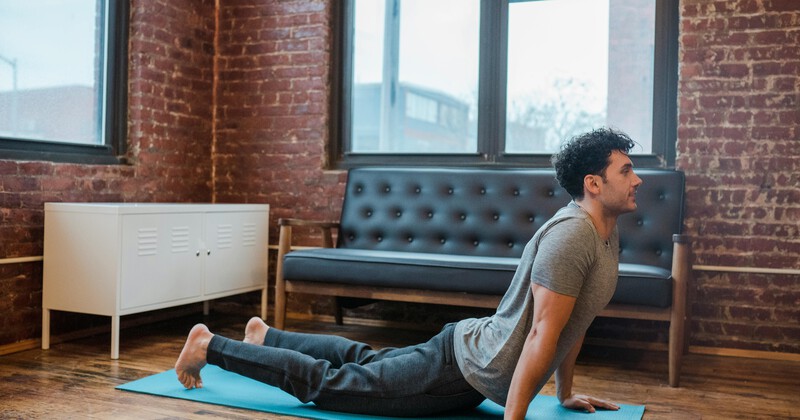
Whilst spot reduction remains physiologically impossible, specific asanas contribute to abdominal toning through core engagement, metabolic stimulation, and stress hormone regulation. These easy yoga poses to lose belly fat support comprehensive weight management strategies when combined with nutritional awareness and cardiovascular activity.
Some Core-Strengthening Poses for Abdominal Toning include:
- Boat Pose Modification (Ardha Navasana): A beginner-friendly core strengthener targeting rectus abdominis and hip flexors without overwhelming intensity
- Sit on the floor with knees bent and feet flat
- Lean back slightly, lifting your feet a few inches off the ground
- Keep knees bent at 90 degrees, extending arms forward parallel to floor
- Hold for 5-10 breaths, maintaining length through your spine
- Plank Variation (Kneeling Plank): A modified stabilisation pose building core endurance and shoulder strength with reduced difficulty
- Start on hands and knees in tabletop position
- Walk your hands forward slightly, creating a straight line from knees to head
- Engage your core, tucking your tailbone and drawing navel toward spine
- Hold for 15-30 seconds, gradually increasing duration with practice
- Dynamic Cat-Cow (Marjaryasana-Bitilasana Flow): A flowing spinal sequence engaging deep core stabilisers through rhythmic movement
- Begin in tabletop position with hands under shoulders, knees under hips
- Inhale, arch your back, lifting chest and tailbone toward ceiling (Cow)
- Exhale, round your spine, tucking chin and tailbone under (Cat)
- Continue flowing between positions for 8-12 breath cycles
Research indicates that regular yoga practice correlates with reduced visceral adiposity independent of caloric expenditure, suggesting hormonal mechanisms beyond simple energy balance³. Stress reduction through yoga decreases cortisol-driven abdominal fat storage as well.
Key Takeaways: Beginner yoga poses support abdominal toning through core strengthening and stress hormone regulation.
Easy Yoga Poses for Mental Health
Easy yoga poses for mental health leverage the somatic-psychological connection, where physical positioning influences neurotransmitter production, stress hormone regulation, and emotional processing.
Some Anxiety-Reducing Forward Folds you can try are:
- Child’s Pose (Balasana): A deeply restorative resting position providing emotional grounding and introspective safety through gentle compression
- Kneel on the floor with big toes touching, knees wide apart
- Sit back on your heels and fold forward, extending arms ahead
- Rest your forehead on the floor or a cushion
- Remain for 1-5 minutes, breathing deeply into your back body
- Standing Forward Bend (Uttanasana): A calming inversion releasing hamstring tension whilst promoting cerebral blood flow and mental clarity
- Stand with feet hip-width apart, hands on hips
- Hinge forward at your hips, keeping your back long
- Let your head hang heavy, bending knees as much as needed
- Hold for 5-10 breaths, clasping opposite elbows or touching the floor
- Seated Forward Fold (Paschimottanasana): A contemplative stretch targeting posterior chain whilst encouraging inward focus and mental quietude
- Sit on the floor with legs extended straight in front
- Inhale to lengthen your spine, exhale to fold forward from hips
- Reach toward your feet, ankles, or shins without rounding your back
- Hold for 8-12 breaths, releasing deeper with each exhalation
Studies show that regular practice of both backbending and forward-bending asanas elevates mood scores in individuals with subclinical depression⁴
Key Takeaways: Accessible yoga postures provide evidence-based mental health support through nervous system regulation, neurotransmitter production, and somatic emotional processing.
FAQs
Easy yoga poses for kids include Tree Pose, Cat-Cow, Downward Dog, Butterfly Pose, and Cobra Pose.
Tree Pose (Vrksasana) is the best balancing pose for beginners. It offers modification options with foot placement at ankle, calf, or inner thigh whilst maintaining stable single-leg standing support.
References
-
Cramer, H., Haller, H., Dobos, G., & Lauche, R. (2016). A systematic review and meta-analysis estimating the expected dropout rates in randomized controlled trials on yoga interventions. Evidence-Based Complementary and Alternative Medicine, 2016, Article 5859729 https://pmc.ncbi.nlm.nih.gov/articles/PMC4927989/?utm_source=chatgpt.com
-
Datta, K., Tripathi, M., Verma, M., Masiwal, D., & Mallick, H. N. (2021). Yoga nidra practice shows improvement in sleep in patients with chronic insomnia: A randomized controlled trial. The National Medical Journal of India, 34(3), 143–150 <i>Yoga nidra</i> practice shows improvement in sleep in patients with chronic insomnia: A randomized controlled trial – The National Medical Journal of Indias
-
Lee, J.-A., Kim, J.-W., & Kim, D.-Y. (2012). Effects of yoga exercise on serum adiponectin and metabolic syndrome factors in obese postmenopausal women. Menopause, 19(3), 296–301. hMenopause
-
Shapiro, D., & Cline, K. (2004). Mood changes associated with Iyengar yoga practices: A pilot study. International Journal of Yoga Therapy, 14(1), 35–44 Shapiro-2004-int-j-yoga-ther.pdf
Get in Touch with Us
We’d love to hear from you—share your thoughts or ask a question!